Science Samplers
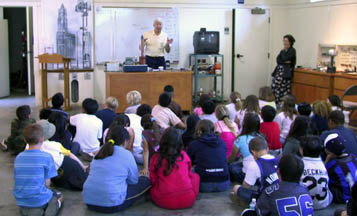
Ideal for field trips and class enrichment, Science Samplers are presentation/workshop sessions abstracted from the Museum of American Heritage workshop series. They are designed age-appropriate for elementary and middle school students. A Science Sampler session is typically 45 - 60 minutes in duration and can be scheduled by advance request as mutually convenient.
Each presentation is a walk-through in time covering events that lead to a specific discovery or invention, integrating history, demonstrations and the theory behind the discovery. At the end of a presentation, students can engage in hands-on activities relating to the topic of the session.
The minimum Sampler fee is $100 for up to 10 students plus $10 for each additional student. With ample advance notice, Samplers can be adapted to emphasize topics of particular interest to students and their teachers. Related take-home projects are also available on request at extra cost. Conducted tours of the Museum before or after the Science Sampler session are also available by advance arrangement. Coordinating the tour with the Sampler Session reinforces the learning experience.
Available Science Sampler sessions include:
Electrical Science: Electricity, Electromagnetism and Electrostatics From Volta, the Italian professor who invented the battery, to Oersted, Faraday, Henry, and Tesla, students walk a time-line of discoveries. Demonstrations include: electric motor, generator, electromagnets, Tesla coil, and more.
Students learn about static electricity by going way back to the days of the Greek scientists and tribo-electricity (creating electricity by rubbing, e.g., cat's fur on amber), and progressing to the monumental discoveries of Ben Franklin, Coulomb, and Michael Faraday. Demonstrations include: Leyden Jar, Electroscope, Van de Graaf Generator, Tesla Coil, and Jacob's Ladder.
Story of Radio Students learn about the history of radio dating back to Marconi and Tesla. Depending on the age of students, basic radio theory is also covered. Demonstration: Crystal Radio
Printing Sampler: The history and workings of the printing press and its supporting technologies are demonstrated in the Museum's own print shop using a variety of presses, papers and inks. The sampler is a two hour class where participants learn a brief history of printing and then practice using a variety of different printing methods, including pressing and rolling of wood block images, and letterpress printing on early 1900's presses. Ink printing can be messy, so please wear appropriate attire. The sampler fee is $100 minimum for up to 10 people and then $10 per additional class attendee.
Puzzles Sampler:
Students learn about the various kinds of puzzles and they all get a chance to play with them. Not all puzzles are jigsaw puzzles! This presentation can easily be integrated with a Mathematics curriculum.
Possible take-home project: Making your own puzzle (e.g. tangram, wooden pyramid puzzle)
The sampler fee is $100 minimum for up to 10 people and then $10 per additional class attendee.
